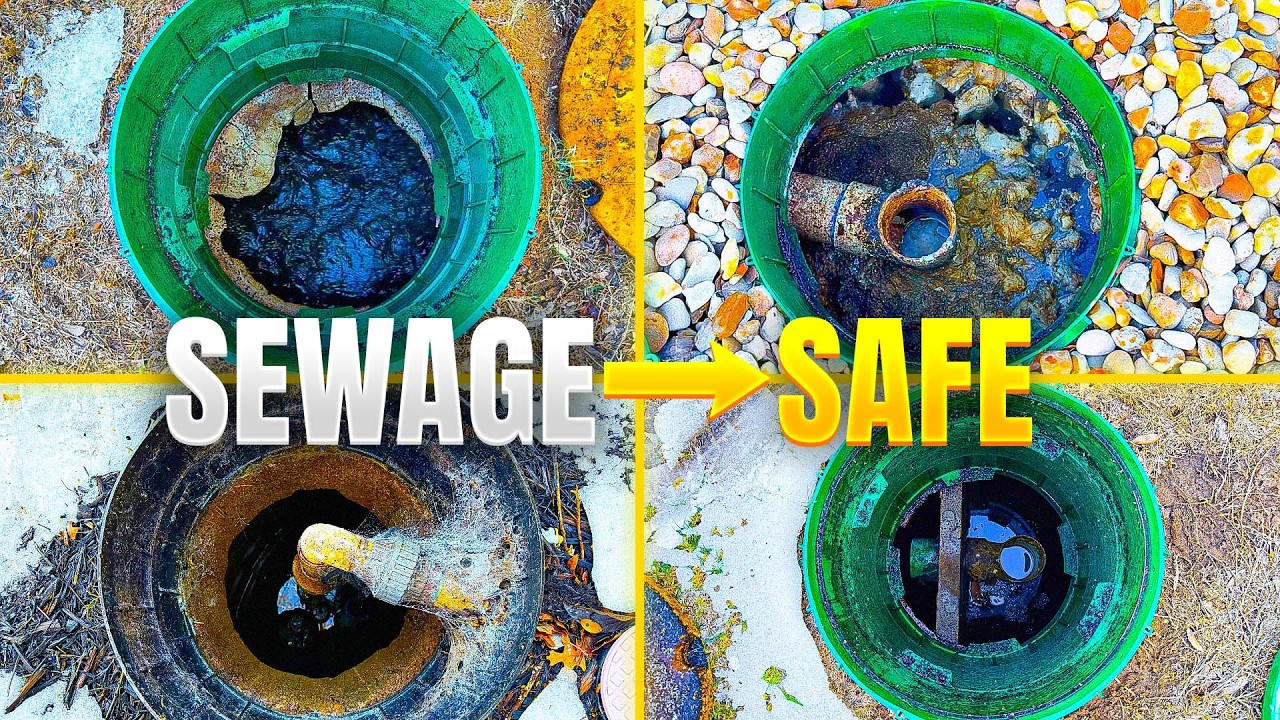

What Do Chlorine Tablets Do in an Aerobic Septic System? (A Central Texas Homeowner’s Guide)
Chlorine tablets in an aerobic septic system are the final disinfection step before your treated wastewater gets sprayed across your yard. If you’re on a sprinkler-style system here in Central Texas, that chlorine isn’t optional — it’s the thing keeping E. coli and other nasty stuff off your lawn, your kids, and your pets. Here’s exactly how often to add them, what kind to buy, and what happens if you let them run out.
Quick Summary
- Chlorine tablets provide the final disinfection stage in an aerobic septic system before treated waste water is sprayed onto your yard through sprinkler heads.
- For most homes, the rule of thumb is about one tablet per two people (in the house) per month.
- In Texas, TCEQ requires active chlorination on any surface-application system (sprinkler system), and we test your chlorine level at every inspection.
- If your system runs out, untreated wastewater ends up on your lawn, which is both a health risk and a compliance problem.
On This Page
- How Often Should You Add Chlorine Tablets to Your Aerobic Septic System (and How Much)?
- Which Tank Gets the Chlorine — and What Type Can You Use?
- What Do Chlorine Tablets Actually Do in an Aerobic Septic System?
- Can You Use Pool Chlorine in Your Aerobic Septic System?
- What Happens If Your Aerobic Septic System Runs Out of Chlorine?
- Frequently Asked Questions
How Often Should You Add Chlorine Tablets to Your Aerobic Septic System (and How Much)?
I asked our technicians this exact question and the simple rule of thumb they give is about 1 tablet per two people per month. So a two-person household is usually a tablet or two a month.
Here’s the big caveat! Anyone who gives you an exact number without asking about your habits is guessing.

The two biggest drivers that dictate how much chlorine your system needs are:
- How many people live there
- How much water you’re running. More people and more water means faster flow, and faster/more flow dissolves tablets quicker. A single person or a couple might go two to three months between additions. An empty vacation property out in the Central Texas Hill Country might go even longer.
Now, a mistake we see all the time: homeowners put too many chlorine tablets in the chlorine basket at one time. Don’t do that. Chlorine tablets swell as wastewater moves past them, and a swollen tablet at the bottom of the tube will push the ones above it up and jam the whole stack. When that happens, the water flows right through without ever properly dissolving a tablet — so you’ve got a full chlorinator and untreated water at the same time. One to two tablets per month per couple actually means adding them on a steady cadence, not dumping in a season’s worth at once.
And don’t wait until you’re at zero to refill. When you open the chlorinator and you’re down to your last tablet, that’s your cue to add more. Running it bone dry, even for a small stretch, means you’re spraying unchlorinated water in the meantime.
Pro Tip
Here’s a seasonal tip most people don’t think about: in the Central Texas summer, tablets dissolve a lot faster. Not because of the heat, but because kids are home from school, families come to visit, and vacation homes are getting used! More people, more showers, more flushes. From June through September, a system that normally needs tablets every six to eight weeks might be burning through them every five to six. We see it on inspections every single year. The easy habit? Set a phone reminder on the same date you pay your electric bill to walk out and check the tablet count, and keep one spare bucket of septic-grade tablets in the garage so you’re never caught short between visits.
Which Tank Gets the Chlorine — and What Type Can You Use?
It depends on what kind of chlorinator your system uses, and there are two common setups (among others).
Tablet Chlorinators vs. Drip (Liquid) Chlorinators
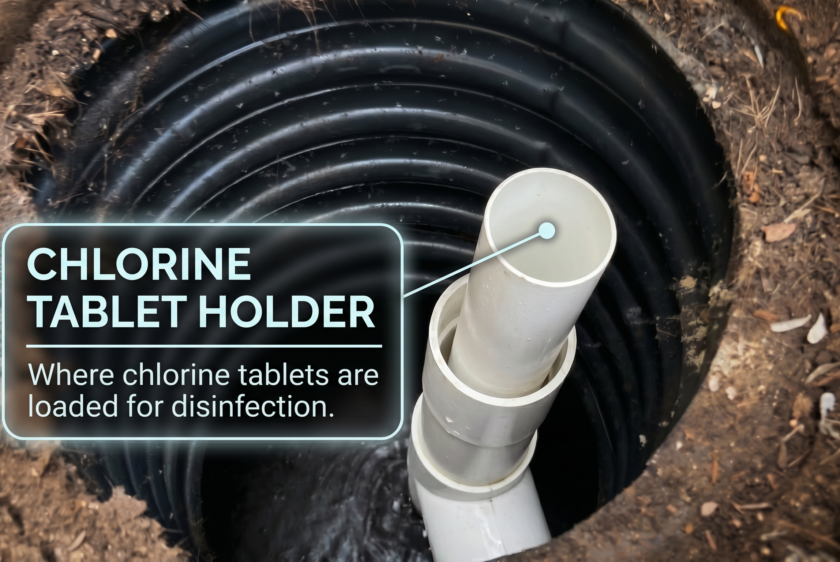
If you’ve got a tablet chlorinator — the kind that uses those physical hockey-puck tablets — it’s generally positioned between the clarifier and the pump tank (that’s between the 3rd and 4th tank). As the water moves from the clarifier into the pump tank, it flows over and around the tablet, and that contact is the treatment. Then the treated water heads out to your sprinklers.
(That pump tank is also where your high water alarm lives. If the red light on your control panel is on, that is a different problem: here is what a red septic alarm means and what to do about it.)
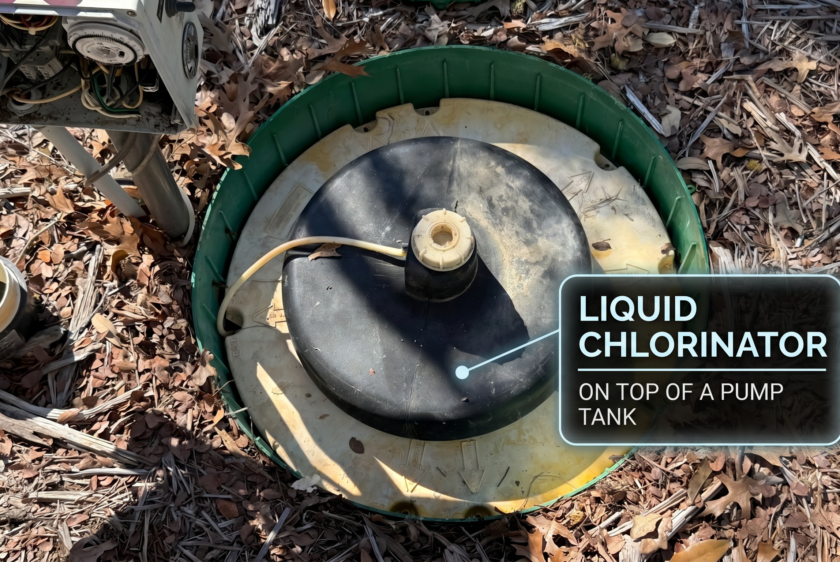
If you’ve got a drip (liquid) chlorinator, it drips liquid chlorine into the pump tank instead — that final stage before distribution. The nice part about a liquid setup is that it tends to be lower maintenance for you as the homeowner. As long as everything’s working, your only real job is topping off the reservoir when it gets low.
Calcium Hypochlorite Tablets vs. Sodium Hypochlorite Liquid
The chemistry matters, and it’s not interchangeable with whatever’s on the shelf. If you’re using tablets, they need to be calcium hypochlorite — a specific type that’s been certified for wastewater treatment (NSF/ANSI Standard 60). If you’re on a liquid system, you’re using sodium hypochlorite. Both are approved specifically for aerobic septic systems. We’ll get into why pool chlorine doesn’t make the cut in a minute, because that’s one of the most common and most damaging mix-ups we run into.
What Do Chlorine Tablets Actually Do in an Aerobic Septic System?
Chlorine is the final kill step before your treated wastewater leaves the system and hits the surface of your yard.
Think about how a surface-application system works. Your aerobic system treats the wastewater, then sprays it out through sprinkler heads onto your lawn — where your kids play, your dogs roam, and your garden beds sit. The aerobic process does a great job cleaning that effluent compared to what comes out of a conventional tank. But “a lot cleaner than raw sewage” still isn’t clean enough to be spraying around your family. Chlorine is what closes that gap.
This is also why it matters more than people think. Untreated effluent landing on your lawn can carry E. coli, coliform bacteria, and other pathogens that put your household — and your neighbors — at real risk of getting sick. That’s exactly why, under TCEQ rules here in Texas, active chlorination isn’t a suggestion on a sprinkler aerobic system. It’s required. And it’s the reason every one of our inspections includes a chlorine residual check.
Can You Use Pool Chlorine in Your Aerobic Septic System?
No. Hard no. This is one of the most common shortcuts homeowners try, and it causes real problems.
Pool tablets and septic tablets aren’t the same chemistry. They dissolve more slowly and they’re a lot more acidic. Septic tablets are calcium hypochlorite, the chemistry TCEQ actually approves and that’s certified for wastewater. Pool tablets are certified for swimming pools, which is a completely different regulatory standard for a completely different job.
Here’s what goes wrong when people use them anyway. That lower pH from the pool tablets can corrode your chlorinator housing and eat at the rubber components inside the system. On top of that, the slower dissolution rate means you often don’t have enough chlorine residual when we come to test — so a technician’s test strip reads a failure, and that’s a compliance issue on your record. And because the chemistries are so different, mixing them around can even trigger dangerous reactions. It’s just not worth it. Now septic blow ups needed…
What Happens If Your Aerobic Septic System Runs Out of Chlorine?
If you run out, your system starts spraying untreated wastewater straight onto your lawn through the spray heads. The water is still aerobically treated — so it’s cleaner than what a conventional system would discharge — but the final disinfection step that makes surface application safe and legal is simply missing.
Big Misconception: Homeowners often think chlorine is designed to dampen septic smells… the truth is, that’s the job of the air compressor/aerator. If you’re septic system is smelly check out this simple diagnostic checklist to see what’s causing it.
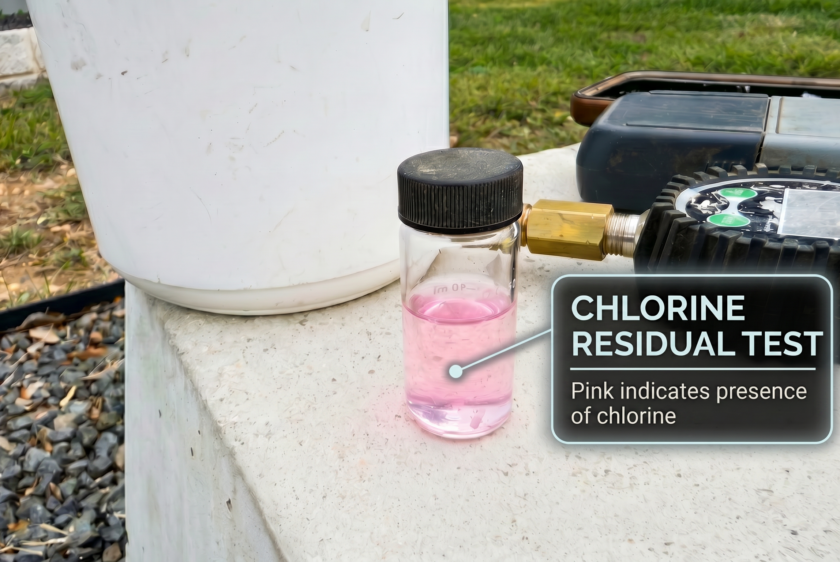
That’s a problem on two fronts. First, the health side: that’s bacterial load landing where your family and pets spend their time. Second, the regulatory side. In Texas, your aerobic system gets inspected three times a year — once every four months — and at each of those visits, your maintenance provider tests the chlorine residual. We’re looking for a reading somewhere in the 0.5 to 2.0 ppm range, with about 1.0 being a great score: enough chlorine to treat the water properly, but not so much that you’re overloading the system. A reading that comes back too low gets logged as a deficiency. If that keeps showing up across inspections, it can escalate into a notice of violation, possible fines, and even a requirement to upgrade your chlorination device. The fix is almost always just keeping tablets stocked, so it’s a frustrating problem to get written up for.
What our Technicians Actually Checks in Your Chlorination Chamber
When we open up your chlorination chamber during an inspection, we’re running through a quick mental checklist. We look at the tablet count in the chlorinator tube. We check the condition of the chlorinator housing for cracking or scaling, we look at the clarity of the effluent in the pump tank. We pull a test-strip residual reading. And we confirm the chlorinator is sitting in the right spot in the flow path so the water is actually contacting the tablet. It takes a little work, but it tells us a lot about how the back half of your system is doing.
Frequently Asked Questions
How do I know if my septic chlorine level is actually right?
The only way to know for sure is a residual test. When we inspect your system every four months, we measure the parts-per-million reading. We’re looking for somewhere between 0.5 and 2.0, with around 1.0 being a great score — enough to treat the water properly without overloading the system.
Can I use pool chlorine tablets if I run out of septic tablets?
No. Pool tablets are a different chemistry (trichlor), more acidic, and not approved by TCEQ for septic use. They can corrode your chlorinator and won’t disinfect your wastewater properly.
How many septic chlorine tablets should I put in at once?
Resist the urge to stack a tall column of them. Tablets swell as wastewater passes over them, and a swollen tablet at the bottom can jam the ones above it so none of them dissolve. Stick to roughly one tablet per two people per month, and refill when you’re down to your last one.
Where do I buy the right chlorine tablets?
Look specifically for “calcium hypochlorite septic tablets” — some products are mislabeled, and you don’t want the pool-section variety. You can see some septic approved tablets here.
What happens if my system fails a chlorine check at inspection?
A low reading gets logged as a deficiency. If it keeps happening across multiple inspections, it can escalate into a notice of violation, possible fines, and a requirement to upgrade your chlorination device. The easy way to avoid all of that is simply keeping tablets stocked.